Search This Blog

Thursday, 27 October 2011

Modifying a Canadian Blonde

As I have posted before, I'm a big fan of Coopers Canadian Blonde, and I slightly prefer it to the Coopers APA, which is often the kit of choice for UK 'kit modders', which will become apparent if you browse through the Kit Brewing forum on Jim's Beer Kit. So for my first 'modified kit' experiment (these posts are out of chrolilogical order, I actually did this one before the 'Stout Old Gentleman outlined below), I thought I would keep it simple and 'Saaz up' a Canadian Blonde. What inspired me was a bottle of 'Saltaire Blonde' that I got on special offer, which is described as;

A straw coloured light ale with soft malt flavours, delicately hopped with Czech and German hop varieties.


So, I thought Saaz would be a good place to start.  Just for the record, the piccy in the right is my crap photography, not official Saltaire promo material! While on the subject of pictures, I'm afraid I didn't take any of this brew, but if you look at the 'Stout Old gentleman' post, you will get the general idea.

Type: Modified Kit Brew
Sugars: 1 Coopers Canadian Blonde, 1Kg Muntons Brew Enhancer, 500g Muntons Extra Light Dried Malt Extract
Yeast: Danstar Nottingham Yeast
Hops: About 75g Saaz, boiled in 5L water + 500g of malt extract, 50% @ 15mins, 50% @ 5 mins
Additions: Water de-chlorinated with 1/2 Campden tablet.
Time in Primary: 3 weeks
Secondary method: King Keg
Time in Secondary: 4 - 5 weeks
O.G. 1050
F.G. 1014

The method for using the hops was as follows. The 500g of Extra Light DME was mixed into about 5 litres of water in a stock pot, which was brought to the boil. Once boiling, half of the hops were added in a muslin bag. After 10 mins, the other half were added and it was left to continue to boil for 5 more mins. Then, it was taken off the heat and the hop bags removed. This was then added to the FV containing the brew enhancer, the kit malt extract, and also used to swill out the kit tin. Once it had cooled sufficiently, the packet of Danstar Nottingham Yeast was thrashed into the wort, and then the FV was placed in my usual builders bucker water bath set to 21 degrees C.

The idea of using the Nottingham yeast was that it was meant to give a clean taste to brews, with little esters, and that is what I thought would suit this style of ale best, what with it using extra lager hops. The first thing I noticed, after fermenting had begun, was the usual 'slight pong' given off by some brews was pretty intense, and had my spare room smelling a bit like a drain for a couple of days! I don't know if this was the hops or the yeast or what, but it was interesting to note.

I left it in the FV under an airlock for 3 weeks to allow the yeast plenty of time to clear up after itself, and it was then king kegged with the usual 80g of priming sugar. It took much longer to come good, after 2 weeks although fully carbonated, it was more cloudy than Gordon Brown's mood on election night, and wasn't fully clear and suitable drinkable until after 4, more like 5, weeks. Oh, and it was really, really hoppy!

After  7 or 8 weeks it was improving, or perhaps my pallet was getting used to the Saaz hops, when a friend came to stay to go fishing. After a long fishing session, ending at the local watering hole, we returned to my house with the customary Chinese takeaway. He asked to try this creation, and was suitably impressed. I showed him how to keep the keg gassed up as he took beer out, and left him to it, with a 'help yourself, there's over thirty pints left'.

The next day, while cooking Sunday lunch for us both, he turned to me and said, 'What am I doing wrong, it's stopped coming out'.

'Erm, that's because the barrels empty, mate'

I will take that as a success, although I didn't get anywhere near the Saltaire Blonde taste. A good first attempt then.

Sunday, 23 October 2011

Stout Old Gentleman

As it was my Dad who got me back into brewing about a year or so ago, I thought I would brew him a batch for his birthday. He likes dark beers, stouts, porters, etc, so with the success of 'Ditches' Coppers, and with a little searching around the Coopers 'How to Brew' website, and reading of Jim's Beer Kit forum, I came up with the following;

Type: Modified Kit Brew
Sugars: 1 Coopers Original Series Stout, 1 Coopers Original Series Dark Ale, 500g Medium Dry Malt Extract, 206g Chocolate Malt, steeped from 0 deg to 70 deg in dry malt plus 5l water, 500g Unrefined Demorera Sugar.
Yeast: Kit Yeast x 2
Additions:Water de-chlorinated with 1/2 Campden tablet.
Time in Primary: 3 weeks
Secondary method: Bottle
Time in Secondary: 3 weeks
O.G. 1064
F.G. 1014


Right, so here is the procedure I used.

1. The ingredients.


The idea was based on the 'tucan' stout on the Coopers website ( one can of Original Stout, plus one can of Original Dark Ale), modified to allow the use of chocolate malt steeped in some dissolved DME, and with some simple sugars, 500g of natural unrefined brown sugar in this case, to add some alcohol 'oopmph' and to give the yeasts something to get their teeth into to ensure a thorough fermentation.

2. The Sanitization.

This is my usual method. All the 'stuff' I need is  placed in a plastic container filled with thin bleach solution. The FV is filled to the top with the same, as is the wide necked FV, which, once rinsed, is filled again with water treated with 1 teaspoon of Campden powder to dechlorinate it.


.
3. Dissolving the Medium Dry Malt Extract.


About 5 - 6 litres of water is put into this stock pot, and once blood warm, the DME is thrashed in.I fond it mixes in really well as the water heats up without excessive clumping.

4. Weighing out the Chocolate Malt.

I was aiming for 200g of malt, but the odd gram here and there in a 23l brew length won't hurt!


5. Starting the steep.

The choc malt is then placed in a muslin bag, which is lowered into the heating dissolved malt and the end tied to the stock pot handle.


Using a thermometer, I keep an eye on this, and leave it in until the dissolved malt mixture hits around 75 degrees C. It then looks like below, having taken on the chocolate malts colour, and (hopefully) its lovely taste.


6. Removing the bag

I then remove the bag (you can see how dark the liquor has become from the little drips in the container below. The malt was then given to a friends pigs (who gobbled it all up).


Meanwhile, the stock pot is left to come to the boil for half an hour or so to kill off any nasties that would taint the beer.


7. Heating the cans.

Meanwhile, the two kit cans have their labels removed and are placed in a sink of really hot water so that the malt extract pours out easily.


8. Adding the sugar.

At this point, after the boil, I stir in the sugar into the stock pot, which as it's a hot liquid, dissolves easily.


9. Pouring the kit cans into the FV,.


10. Washing out he cans.

Once they have been poured into the FV, the cans were then washed out with the boiled wort, and added to the FV from a decent height, and it all thrashed around.


Once cooled to about 25 degrees C, the two kit yeast sachets are pitched, the FV placed in a builders bucket, with water poured in to bring it up to the top level of the FV. A 25W immersion fish tank heater is added, and set to keep it at a steady 20 degrees C. I didn't put the usual airlock in the bung, as I knew the dark coopers kits like to go mental, so I used a sanitized old syphon tube as a blow off tube, running down to the liquid in the builders bucket as a sort of improvised air lock. Thank god for that, as it went well and truly mental;


11. Batch priming and bottling.

Not many photos here, I'm afraid, but the FV was left for 3 weeks, and the gravity had dropped from 1064 to 1014, steady over 3 days. It was bulked primed with 60g of sugar, and bottled. 3 weeks in the warm, then 2 and a half months in the cold, resulted in the following;


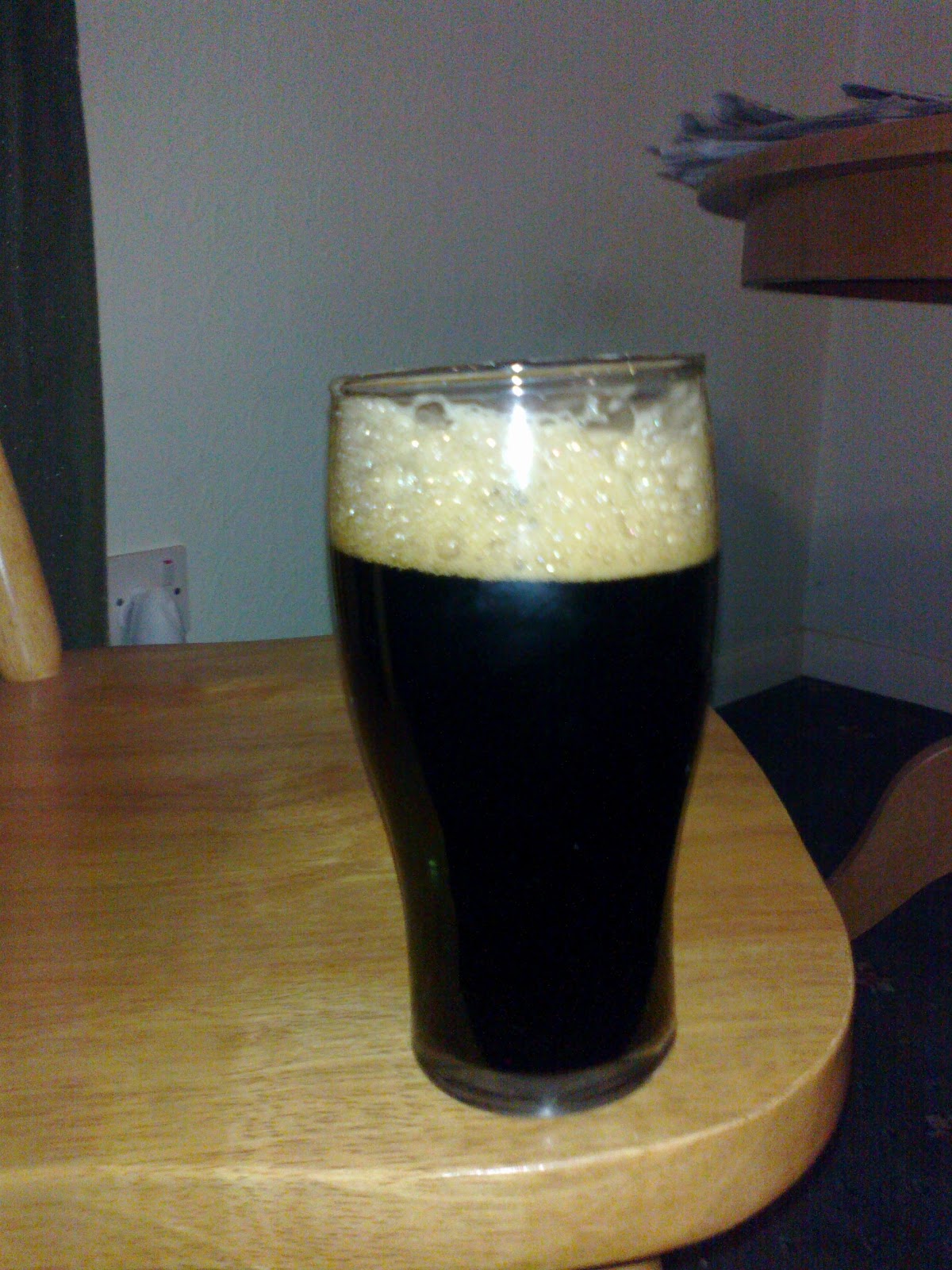
The result was amazing. Really chocolate, coffee notes, and real body. I can't really explain how fantastic this was. Anyway, the proof of the pudding is in the eating, so after applying some labels designed by a family fried who is an artist, we had the following ready for Dad's birthday dinner party;


Did they go down well? Oh yes........

Monday, 8 August 2011

Coopers Dark Ale

Type: Kit Brew
Sugars: 1 Kg Medium dry malt extract (Muntons), 250g Unrefined Brown Sugar.
Yeast: Kit Yeast
Additions:Water de-chlorinated with 1/2 Campden tablet.
Time in Primary: 2 weeks
Secondary method: Keg
Time in Secondary: 2 weeks plus (nearly 3)
O.G. 1044
F.G. 1012

I thought I would give this one a whirl, as I was interested as to exactly what a 'dark ale' was. I used the same additions as with the 'Ditch's' stout below, as there was a fair amount of opinion on Jim's Beer Kit forum that this was the way to go.

After the usual 2 weeks in the FV, it went into a King Keg. I was originally going to bottle this one, but ran out of time on bottling day, so into a King Keg it went.


It took nearly 3 weeks to become drinkable, more really, as it improved with age. Perhaps I should have bottled it after all. Did I like it? Well, yes and no. I was hoping for more caramel / choc malt notes, as with some German Dunkel or dark lagers, but it was a bit bland for my tatse. It was better towards the end of the barrel, and I may try this again with a lager yeast and some additions to try and get to a Dunkel type of outcome, but that will have to wait until the cold weather arrives later this year. I suppose the biggest problem was that I had never drank a bottle of Coopers Dark Ale produced by their brewery, so I had no datum point.

Verdict? Interesting, but a little disappointing. Yikes, I've actually found a Coopers kit that I can give a less than 10 out of 10 review to!

Saturday, 9 July 2011

Coopers Original Series Stout ~ 'Ditch's recipe'

Type: Kit Brew
Sugars: 1 Kg Medium dry malt extract (Muntons), 250g Unrefined Brown Sugar.
Yeast: Kit Yeast
Additions:Water de-chlorinated with 1/2 Campden tablet.
Time in Primary: 2 weeks
Secondary method: Keg
Time in Secondary: 2 weeks
O.G. 1056
F.G. 1012


On the Jim's Beer Kit Forum, in the kit brewing section, there is a 'sticky' that has numerous replies and recommendations, for 'Ditch's recipe stout'. Basically, it's a Coopers Original Series Stout made up with 1Kg of medium dry malt extract, and about 250g of unrefined brown sugar. Such were the reviews, that I thought I would give it a try.

A miscalculation on my part saw it being brewed to 20L rather than 23, so it came out with a higher gravity than the original post. The fermenting beer goes absolutely crazy, with foam crawling up the FV and trying to escape through the airlock. This didn't cause me any issues, as I keep mine in a builders bucket partially filled with water, and an aquarium heater, but it's worth looking out for if you don't do this.

After 2 weeks, into the King Keg it went with 80g of priming sugar in solution, and after a further 2 weeks it was drinkable.

Lovely dark stout, with a thick head that lasts to the end of the pint. Chocolate and coffee notes, and a lovely smooth taste. Considering how simple to make this was, and how quickly it becomes drinkable, one the colder weather returns, I will be doing this kit / method again, and again...

Saturday, 11 June 2011

Coopers Sparkling Ale

Type: Kit Brew
Sugars: 1.5 Kg Liquid Light Malt Extract, 500g Light Dry Malt Extract, 300g Brewing Sugar (Dextrose)
Yeast: Kit Yeast
Additions:Water de-chlorinated with 1/2 Campden tablet.
Time in Primary: 2 weeks
Secondary method: Bottle
Time in Secondary: 6 weeks plus
O.G. 1064
F.G. 1014

 There is a deli in my local town, Louth, that sells a fairly good range of both imported and domestic beers. Having brewed a number of Coopers kits, I was interested to see they had Coopers Sparkling Ale in 330ml bottles, all be it at an eye watering price. Fair enough, this stuff has come all the way around the world.

Coopers Sparkling Ale is a bottle conditioned ale, so there is a layer of yeast in the bottom of the bottle. just as with home brewed, bottled beer. Apparently, aussie drinkers are split between those who pour the beer carefully to avoid disturbing the sediment, and those who gently 'roll' the bottle to incorporate it into the brew. I settled on the former, and found it to be a nice, crisp, malty brew that I really enjoyed.

A couple of weeks later, and I walk into my home brew shop, and what have they just got in? Some of the 'Thomas Coopers Selection' kits for the first time. Marketed by Coopers as being for those who want to put a bit more effort, in terms of ingredients, into their brewing, I had to have a bash. I couldn't believe my eyes when I looked at their recommended list of fermentables ~ 1.5Kg of liquid malt, 500g of dry malt and 300g of dextose, but in for a penny...

It was a while before I got this kit on the go, as it really needs to be left down to condition for at least a month, so it had to go into bottles, which I needed to acquire. One of my friendly local boozers obliged, and I set about making it up. Apart from the fancy ingredients list, the brewing process is identical to other Coopers kits. The supplied yeast looks like yeast based hundreds and thousands as it is made up of both an ale and a lager yeast, which have slightly different colours. Brewed at a steady 21 degrees C, it was left under the air lock for the normal 2 weeks, then bottled. By then, it had reached a steady 1014, slightly higher than you would get if you just used brew enhancer, for instance, as there are more non-fermentable sugar components in malt extract.

The result? Amazingly close to the original, and a really nice brew. More expensive per pint, obviously, but a worthwhile enterprise all the same. Yet another blinder from Coopers.

Sunday, 22 May 2011

Brewferm Triple

Type: Kit Brew
Sugars: About 600g of Golden Syrup
Yeast: Kit Yeast
Additions:Water de-chlorinated with 1/2 Campden tablet.
Time in Primary: 2 weeks
Secondary method: Bottle
Time in Secondary: 6 weeks plus
O.G. 1064
F.G. 1010


An interesting range of kits, these, mostly comprising of Belgian beers, but with the odd pilsner thrown in. Most of them make up smaller batches than your standard kit, despite the kits themselves being in the usual size cans. The instructions are also more complicated than standard, suggesting the use of Belgian Candi Sugar, and insisting on batch priming (explained below). OK, I know many people will batch prime their brew if bottling as a matter of course, but it's interesting that Brewferm suggest this as a required step (and no bad thing, that).

I couldn't get Candi Sugar easily, and making up the required amount manually (i.e. inverting normal sugar myself) appeared a bit of a faff, so I used golden syrup, which is a partially inverted sugar. Searching online gave me the required quantities (you need to use 20% more Candi sugar than if using simple sugars, and then have to take account of the liquid in the syrup, so 600g appeared about right). I also used a smaller 15L fermentation bid, as I thought the 9L that this kit makes up would look a little lost in a 5 gallon bin!

Have a look at the original and final gravities, and you will notice this is one string brew. Online opinion suggested a good 3 month maturation would be required in the bottle, but mine was smashing after 6 - 8 weeks. But, boy, is this stuff strong. It has a slightly syrupy, spicy taste, but isn't sickly. It also has the effect of preventing your legs from working if you drink too much.

Really impressive stuff, this. One of the best brews I have ever done, and will be trying others in their range. Next time, however, I am going to to set this down in smaller bottles, as a pint of this stuff is just a bit too much.

Coopers European Lager

Type: Kit Brew
Sugars: 1kg Brewing Sugar (Dextrose)
Yeast: Kit Yeast
Additions:Water de-chlorinated with 1/2 Campden tablet.
Time in Primary: 3 weeks @ 15 degrees C
Secondary method: Bottle
Time in Secondary: 3 months
O.G. 1040
F.G. 1006


I've done this kit twice. The first time, it was the first kit I did after returning to home brewing after many years. I didn't do my research on this one, didn't brew it at the correct temperature, didn't leave it long enough in the King Keg, forgot to prime the King Keg, didn't De-Chlorinate the water, and generally ended up with a rather poor brew.

However, after getting a number of sucsessful kits under my belt, I thought I'd try this one again. Unlike many 'lager' kits on the market, this one ships with a proper, bottom fermenting, lager yeast. This means that it really needs to be brewed at a much lower temperature than those that ship with an ale yeast. I managed to find a spot in the house that was a nice steady 15 degrees whatever the time of day, and left it to ferment there for three weeks under an air lock. I also learned, from my online research, that using spray malt instead of simple sugars can throw the balance of this kit off a bit, so I stuck with 1Kg of brewing sugar.

As warned in the instructions, the yeast gave off a rather 'bad egg' smell at various times during fermentation, and that was still detectable at bottling time. Although I was determined to leave this for the advised (online) 3 months, I opened a bottle from time to time to check progress. After 2 - 3 weeks, it still had a rather sulphuric king of twang and wasn't nice at all. Over the coming weeks, this dissipated and gradually it started to taste like a proper lager.

After about 3 months the result was totally transformed. A lovely, crisp, Beck's like lager that has great carbonation. Not an especially complex beer, but nice and refreshing all the same.

If you like Becks, give this one a go. Just be prepared to bottle it, and wait. Oh, and don't forget the lower fermentation temps!